Three months' notice is typical
Most LiveTiles contracts we have seen require three months' notice to terminate.
For LiveTiles and Wizdom customers
We were the UK reseller for LiveTiles and Wizdom. We do not sell either now, and we have no commercial interest in Omnia - so we can be straight with you about the options, including when the answer is that you do not need another product.
A senior consultant replies within one working day.
Before anything else
Work backwards from your renewal. If it falls inside the next six months, the evaluation needs to start now rather than after the reminder email.
Most LiveTiles contracts we have seen require three months' notice to terminate.
A migration typically takes four to eight weeks, so the decision has to be made earlier than the renewal date suggests.
Work backwards from your renewal. If it falls inside the next six months, evaluation is already time-critical.
Context
Three things happened, none of them to do with whether the product was any good.
December 2023
LiveTiles entered receivership and was suspended from trading on the Australian Securities Exchange, with KordaMentha appointed as receivers.
Since
LiveTiles is now part of Omnia, and its own website directs visitors to Omnia for information. A change of owner is a reasonable moment to review a platform decision.
14 July 2026
Microsoft ended support for SharePoint Server 2019. LiveTiles' own documentation tells customers running on it that upgrading to Subscription Edition is necessary, not optional.
The intranet decision sits on top of an unsupported platform, so getting to SharePoint Online comes first. That is a migration project in its own right, and it is work our parent consultancy Content Formula does. Worth knowing before anyone quotes you for an intranet.
Why us
Most of the LiveTiles customers we have migrated were our clients before they were LiveTiles clients. We found them, and we put them onto the product.
That matters, because it explains what this page is. We are not a competitor who spotted an opportunity in somebody else's difficulty. We sold the platform, implemented it, supported it, and listed it alongside Wizdom and Hyperfish on G-Cloud. When it launched, SharePoint out of the box could not deliver a branded, navigable intranet without significant custom build, and a product layer was the sensible answer. The platform has not got worse - Microsoft caught up, and the value of paying a second licence narrowed.
We eventually stopped recommending third-party overlays and built our own, designed to sit inside the tenant rather than beside it. That is the whole origin of Lightspeed365, and it is why our migration is automated rather than manual: we know the data model because we used to install it.
Your options
Being clear about the one we do not is the point - you can weigh it without us in the room.
We do not do this
Omnia is a fully featured intranet platform that integrates with SharePoint. It is a capable product with an active roadmap and a vendor behind it. Worth evaluating properly rather than dismissing. This is still a migration - Omnia is a different product, not an upgrade in place - and it continues the second licence and the second platform to govern. A legitimate choice, and for some organisations the right one. We do not deliver this path - Omnia and its own partners do.
We deliver this
Drop the product layer entirely and rebuild on what your Microsoft 365 licence already includes. No additional licence at all. One platform to govern instead of two. You lose whatever the product layer was doing for you. Genuinely the answer for some organisations. Whether it is yours depends entirely on the gap analysis below.
We deliver this
Replace the product layer with one that installs from the SharePoint app catalogue and runs entirely inside your own tenant. Everything stays in your tenant - no external hosting. Over 30 web parts, branding tools, Teams app. Automated migration of structured content. Typically four to eight weeks end to end, often driven by a decommissioning deadline.
The decision
This is a gap analysis, not a demo. Native SharePoint does more than it used to - the honest question is which of the modules you currently rely on have a native equivalent, and whether the ones that do not actually matter to you.
More than most LiveTiles deployments were built to assume, because most of them predate it. Audience targeting on news, navigation links, web parts and page sections. Mega menu navigation. Hub sites for departmental structure. Comms and HR publishing on communication sites. Teams and mobile access through Viva Connections. News, events, quick links, highlighted content, and search verticals.
The LiveTiles and Wizdom modules with no direct native equivalent: Noticeboard, People Directory and Hyperfish profile completion, polls, birthdays, cafeteria menu, new employee module, push notifications via the LiveTiles Reach app, policies and procedures lifecycle, visual customisation of navigation, and templating that is not manual. Which of these you would miss is the whole decision.
They wanted the most cost-effective route and were seriously considering SharePoint Online out of the box. We ran the gap analysis before recommending anything, and in their case the gaps were wide enough that native alone would have been a significant step backwards. We would have said so either way.
Architecture
Worth knowing before you migrate, because it determines what can be moved and what has to be rebuilt.
Per LiveTiles' own technical documentation: pages, lists and documents sit in your SharePoint environment, but configuration, branding and logic are rendered by the Wizdom back-end outside SharePoint. The Noticeboard stores posts in Azure and its data in a separate SQL database, then pushes it back into SharePoint. Hyperfish scans Active Directory using a locally installed agent. A normal architecture for when it was built. It is also why a migration is not a copy.
Installs from your SharePoint app catalogue. Content, configuration and branding stay inside your own tenant, with no external hosting, no separate database and no agent installed on your network. Your existing Microsoft 365 security and compliance posture applies without a second assessment. One platform to govern instead of two, which is usually the argument that lands with IT rather than with comms.
Proof
Automated content migration, with scripting where modules have no direct equivalent.
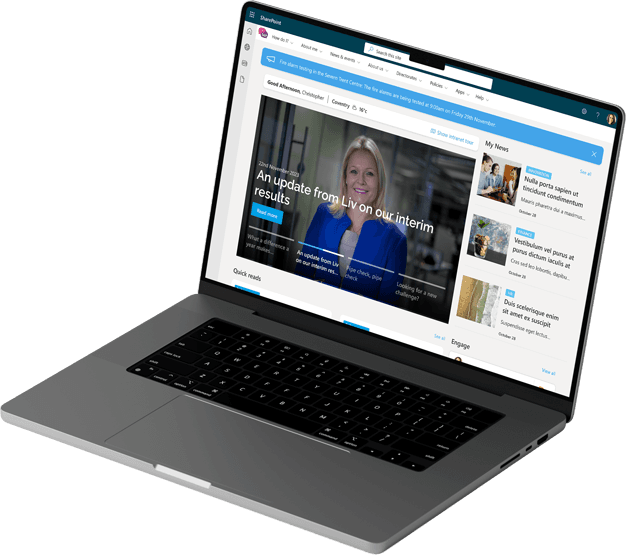
We had implemented their original LiveTiles intranet ourselves. When it reached end of life they came back to us, and we migrated 8,500 staff - many of them frontline - with news from the old Noticeboard scripted directly into SharePoint news.
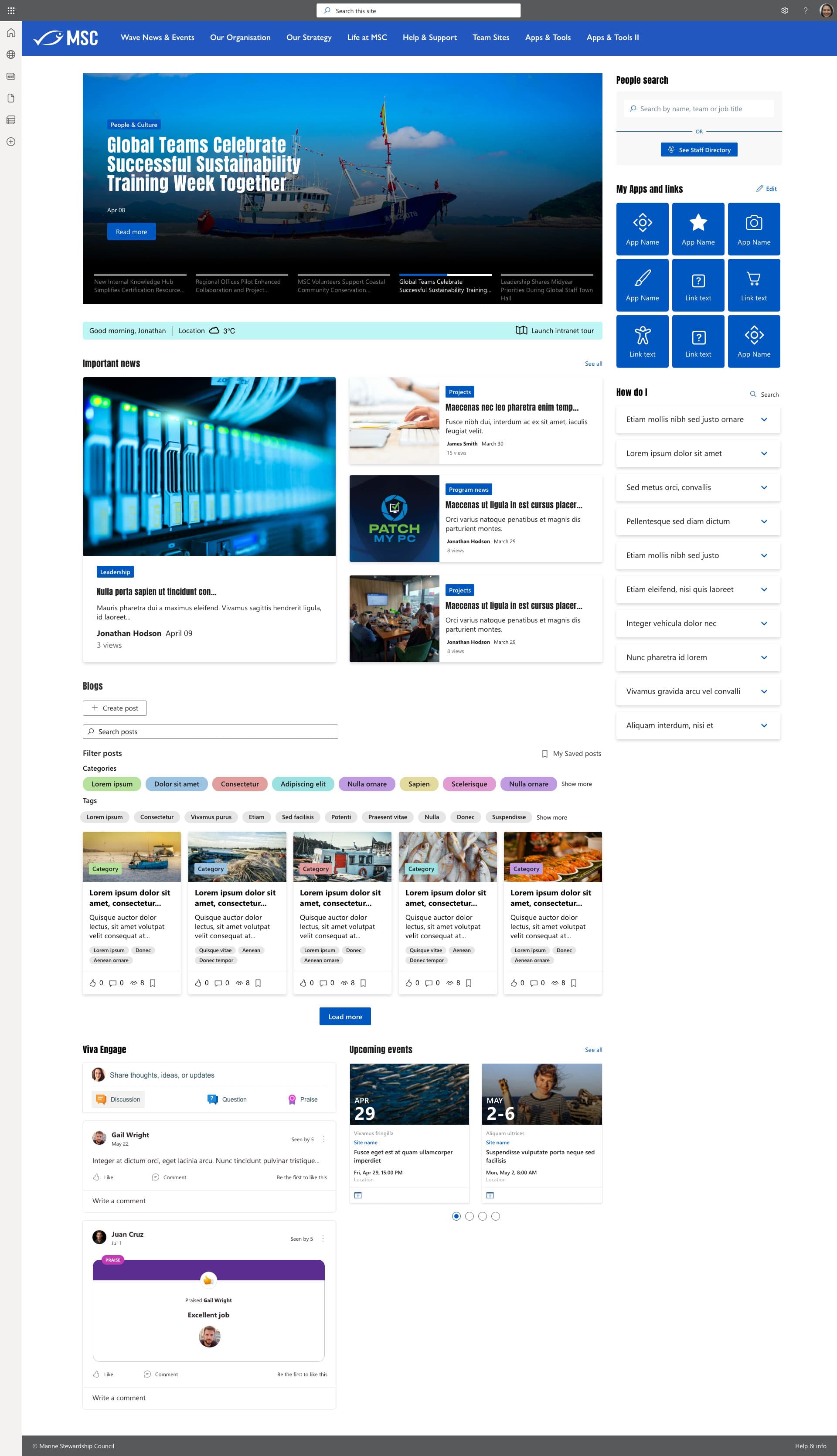
A phased LiveTiles to Lightspeed365 migration of The Wave covering a redesigned homepage, News feed and Noticeboard, with around 600 news pages and 300 noticeboard posts moved across.
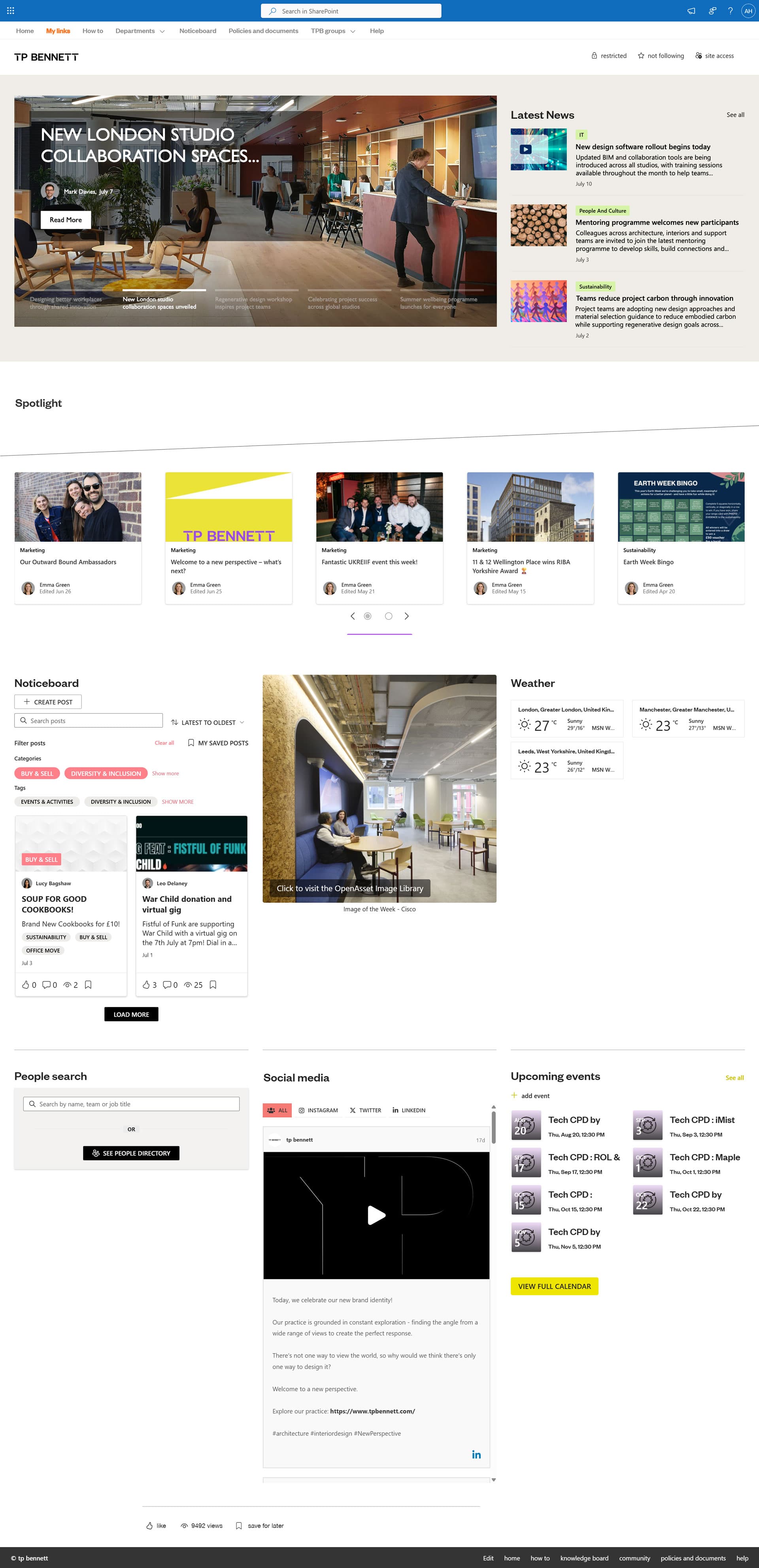
A like-for-like LiveTiles Hub and Reach switchover that preserved brand, personalisation, and targeted communications, then opened the door to features LiveTiles could not offer.
Delivery
Four phases. Scope is agreed before any build starts, and validated again before content moves.
An automated audit of your existing platform identifies every third-party component, web part and custom configuration in use. You get an analysis report mapping what exists, what migrates directly, and what needs rebuilding or retiring. Migration priorities and scope are agreed with you before anything is built.
Your branding is applied using the Lightspeed365 brand customiser, the homepage is rebuilt around your current design and any updated requirements, and navigation is restructured. Lightspeed365 packages are installed into your SharePoint environment.
Structured content types - noticeboards, FAQs, quick links, announcements - are migrated to their Lightspeed365 equivalents. Scope is validated against the phase 1 analysis. Manual web part replacement on individual pages stays with your team, with training and guidance from us.
Old platform service and app packages are removed. Content editors get around four hours of training plus self-service tutorials, then a user acceptance period of roughly ten working days before go-live support.
Most of these migrations are driven by a decommissioning date rather than an ideal schedule, so the honest constraint is usually yours rather than ours. What moves the number: how many pages and content types exist, how much sits in features with no direct equivalent, whether navigation and information architecture are being kept or redesigned, how many languages and regions are involved, and whether you are also moving from SharePoint Server to SharePoint Online first. The phase 1 analysis prices all of it before you commit.
Not with a demo. Tell us what you have and what it needs to do, and we will tell you honestly whether native SharePoint covers it, whether Lightspeed365 is worth the licence, or whether staying where you are is the sensible answer for another year.
Common questions