By Joe Perry, technical director
Powered by Lightspeed365. Delivered by our team at Content Formula, the consultancy behind Lightspeed365.
Summary
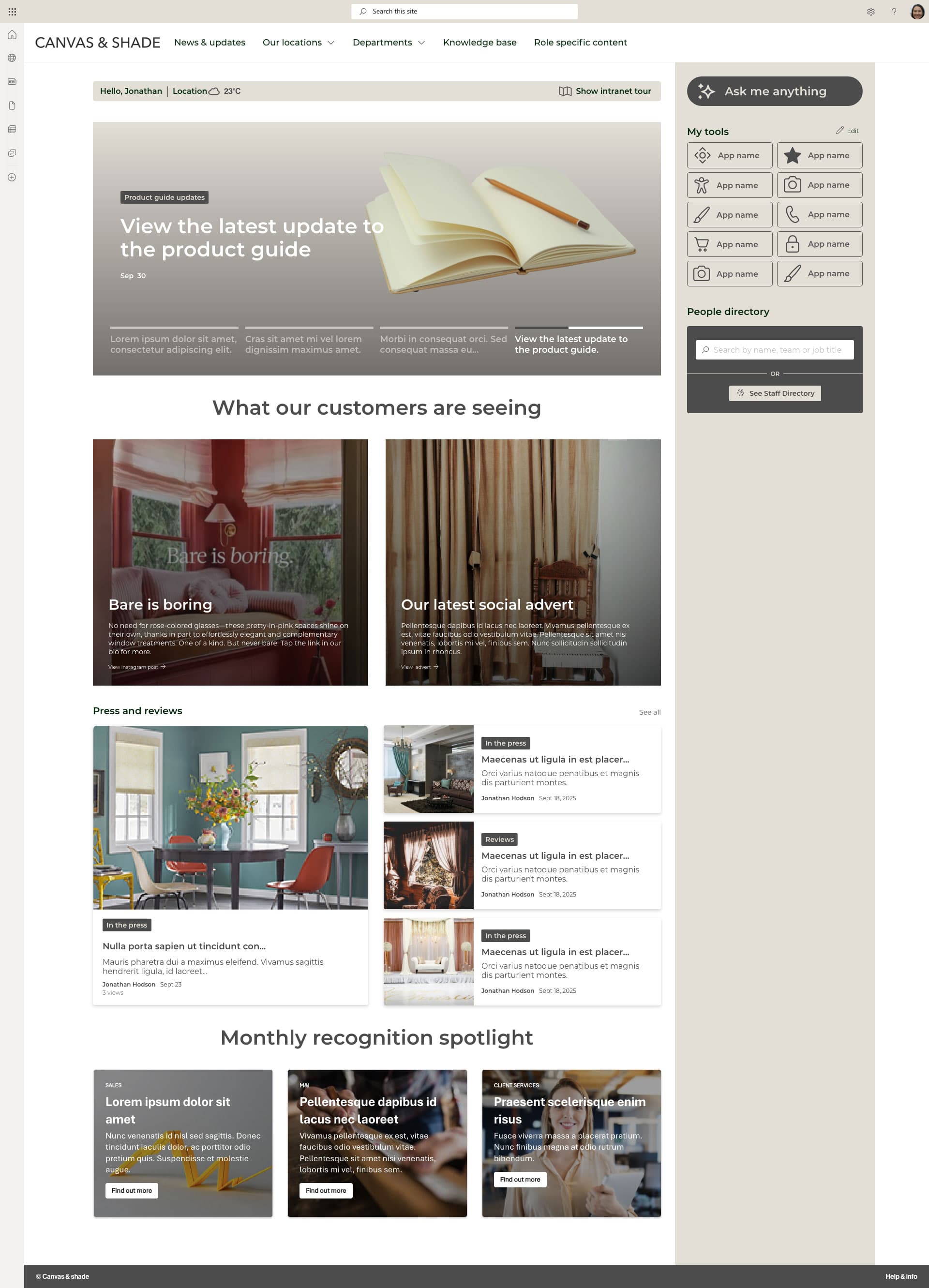
This custom window treatments retailer relies on a large frontline workforce, salespeople in showrooms, installers working in customers' homes, and customer service teams spread across several sites, to sell and deliver its products. Getting the right information in front of the right people had become hard work: resources existed but were difficult to search, and there was no way to tell whether an internal update had actually landed with anyone. We built a Lightspeed365 intranet with the retailer, prioritising audience mapping and content structure ahead of design so the platform could serve a workforce that is rarely at a desk. The client's own team now runs day-to-day content and communications, and the intranet is already in active use ahead of a planned rollout to corporate teams.
The challenge
The need for a better intranet came out of a practical operating reality rather than a wish list. This custom window treatments retailer sells and fits its products through a large, dispersed workforce: around 300 salespeople across 150 showrooms, around 200 measure-and-install professionals working in customers' homes, and customer service teams split across multiple locations. Important information existed in plenty of places, much of it sitting in numerous large documents: training materials, product guides and process handbooks, with no consistent way to search or filter within them. Findability was as much the problem as the number of channels. What was missing was one reliable route for employees to find it.
Communications ran through a patchwork of bi-weekly newsletters, national video calls, email and a handful of Teams channels. That is workable for a single office. It is a harder proposition for people who are rarely at a desk and rarely on the same call at the same time. Visibility of engagement was effectively zero: there was no way to know whether an update had reached the people it was meant for, or whether it had landed anywhere at all.
The retailer needed a partner that could design a well-structured, user-centric intranet able to act as the front door to the wider digital workplace, introduce audience targeting and better communications capabilities for a distributed frontline workforce, and support a phased approach that left the internal team able to manage and develop the platform after launch. That last point mattered as much as the other two: a platform that only the delivery team can maintain is not a platform the client actually owns.
Does this sound familiar? Speak to our team to see how we can support your challenges.
The approach
Why start with taxonomy and audience mapping before building anything?
Our team worked with the retailer through a structured discovery and build programme, covering the intranet workstream from initial stakeholder workshops through to go live and launch support.
The discovery phase focused on understanding the audience mix and the practical needs of a dispersed workforce. That meant stakeholder workshops, a review of existing systems, taxonomy and content type recommendations, and an analytics session, in that order. The reason for that sequence is straightforward: you cannot design useful audience targeting or a workable navigation structure until you know who the audiences actually are and what content types they need to find. Skipping that step and jumping straight to homepage design tends to produce a page that looks right and works for nobody in particular.
Discovery fed into a strategic recommendations presentation and a set of homepage and page template designs. The build phase then delivered the configured intranet environment, with our team completing a knowledge transfer and supporting the client's team through content creation and launch.
What was delivered
Our consultants proposed and delivered a Lightspeed365-based intranet built on SharePoint, tailored to the operational needs of the business. In practice, that meant:
- A customised intranet homepage, along with a role page template and a department page template that give content owners a consistent, ready-made structure to build from. In practice, that means new role and department pages go up looking and working the same way as the rest of the site, rather than each one being designed from scratch.
- Audience-targeted communications through Lightspeed365's News feed and Lightspeed365 Alerts, with Push Notifications available to activate when ready. This answers the original problem directly: instead of one newsletter going to everyone, the right update reaches the right audience through the channels people actually check, and push notifications give the business a way to extend that reach to mobile as the rollout matures.
- Hubsite navigation, and taxonomy and content type setup to support findability and content governance across the environment. The taxonomy work is what makes the rest of the structure hold together: without a consistent set of content types and terms behind it, navigation and search both degrade as more content gets added over time.
- Department pages and a knowledge page, giving teams a structured home for resources and guidance. This moves the intranet beyond a communications channel into a working resource people return to for an answer, not just when there is news to read.
- Microsoft Clarity, set up to give visibility of how employees engage with content. This closes a gap that had existed since the previous approach relied entirely on newsletters and email that nobody could measure.
- Training for content editors and administrators, so the platform is not dependent on the delivery team once the project ends. The client's team can create pages, manage content and extend the site themselves, which is what makes a phased rollout sustainable rather than a one-off launch.
Curious what else Lightspeed365 can do? Explore the full feature set.
Explore Lightspeed365 features
Why it mattered
For this retailer, the intranet was never meant to be a repository. The aim was a place employees could branch out from into the rest of their working day, useful in the flow of work rather than available in theory somewhere on the network.
Building in audience targeting and analytics from the start reflects a straightforward point about distributed workforces: a single communications channel cannot do the job when the audience is spread across 150 showrooms, customers' homes and several service locations. The retailer needed confidence that updates were actually reaching people, not just being sent to them. Without that visibility, the same problem would simply have resurfaced in a new interface: information technically available, still not reliably reaching the people who needed it.
A strong outcome from this project is that the intranet launched into active use with field teams, with the retailer establishing a regular cadence of publishing and iterating on the platform from day one. Plenty of intranets launch and then stall once the delivery team steps back; this one kept moving because the people using it were already comfortable running it. The retailer is now planning the next phase of rollout to corporate audiences.
Why Lightspeed implementation services were the right fit
A rollout spanning 150 showrooms, several hundred field-based staff and customer service teams in different locations is not a sequence many internal teams get right on a first attempt. Getting taxonomy and audience mapping done properly before touching homepage design, then building governance and training into the plan from the outset, is the kind of work that benefits from a team that has run this sequence before. That is what Lightspeed implementation services adds on top of the platform: delivery expertise applied to a rollout that could easily have taken twice as long, or produced a homepage that looked right in a demo and worked for nobody in particular, if the steps had been taken in the wrong order.
For a retailer without the in-house capacity to run a discovery phase and design workshops alongside day jobs, that combination of expert delivery and a platform built for distributed, frontline-heavy organisations is what got this intranet live and into daily use rather than stalled in planning.
If a similarly dispersed, frontline-heavy workforce sounds familiar, our consultants can help you get there without the trial and error. Take a look at our pricing and implementation options.
Get in touch to talk through what a similar rollout would look like for your organisation.
Read more Lightspeed365 case studies to see how other organisations have transformed their SharePoint intranet.